1. Patient Overview
- Name: James Heneghan
- Age at Treatment: 27–28 (commenced treatment 2021)
- Gender: Male
- Occupation: Civil Engineer (Construction)
- Location: Perth, WA (relocated to Sydney, NSW)
- Type of Hair Loss: Androgenetic (genetically predisposed, fine/thin hair baseline)
- Duration of Hair Loss: Approximately 8–10 years of progressive thinning prior to treatment
- Stage/Severity: Moderate diffuse thinning, compounded by naturally fine hair texture from baseline
2. Presenting Problem
James presented to Boss Clinic’s Subiaco location in 2021 with progressive diffuse thinning across the scalp. His hair had always been naturally fine and light — a characteristic shared with his father — but by his late twenties, the thinning had become noticeably more pronounced.
- Areas affected: Diffuse thinning across the scalp. Due to his naturally curly, fine hair texture, thinning was particularly visible when hair was wet, in direct sunlight, or worn short.
- Rate of progression: James had first noticed thinning around age 18. By his late twenties, a barber had commented that he would likely be fully bald before 30. This prompted him to take action.
- Scalp and hair characteristics: Naturally fine-diameter hair strands with tight curl pattern. The combination of fine texture and thinning created a particularly visible presentation — the curl pattern that would typically add visual volume was unable to compensate for the reduced density.
- Previous treatment attempts: James had sought a consultation at a hair clinic in Dublin at approximately age 20. He was advised he was not a suitable candidate for a hair transplant and that even halting the progression would be difficult. He was offered laser treatment but could not afford it as a college student. No further treatment was pursued for approximately seven to eight years.
- Contributing factors:
- Genetic predisposition (paternal lineage — father and uncle share similar hair characteristics)
- Extended sun exposure in Australia accelerating visible scalp visibility
- Some inconsistency with any previous topical product usage
3. Patient Motivation and Concerns
James relocated from Ireland to Australia in 2020, moving first to Sydney and then to Perth in 2021. The Australian climate amplified his concerns significantly. The intensity of sun exposure in Perth made the thinning more visible, and lifestyle activities common to the region — swimming, beach outings — became sources of self-consciousness rather than enjoyment.
- What prompted him to act: James was searching for a barber and was directed toward a business called Boss Barber. Googling “Boss” led him to Boss Clinic. He noticed the consistently positive reviews and, given that the initial consultation was free, decided to book.
- Emotional drivers at the time of consultation:
- Self-consciousness around outdoor and social environments where hats were not an option (beaches, pools, formal events)
- Growing awareness that hair appeared more noticeably thin when wet
- A comment from a barber that he would be bald before 30 created urgency
- Hesitations and misconceptions: James arrived at the consultation with low expectations. His previous clinical experience had reinforced the belief that his hair could not be regrown. He described himself as “resigned” to going bald, and felt that his naturally thin hair had set an upper limit on what any treatment could achieve. He came in open to information but not expecting to proceed.
4. Clinical Assessment and Diagnosis
Debra’s clinical observations at initial consultation:
James presented with a manageable degree of hair loss for his age and profile. Despite his previous consultation advising otherwise, Debra assessed his case as well-suited to the Boss Clinic treatment approach.
Key factors:
- James was in his late twenties — younger patients typically demonstrate faster and more pronounced treatment responses
- Hair loss had been progressing for a relatively short period in clinical terms
- Scalp condition was responsive
- No significant scarring, inflammation, or compounding scalp pathology was noted
Likely cause: Androgenetic hair loss with a strong genetic component (paternal family pattern). Lifestyle factors including prolonged sun exposure in Australia likely contributed to perceived worsening.
Prognosis: Debra was confident about the treatment outcome from the first consultation. She communicated this directly to James, noting that his age, overall health, and the relatively recent acceleration of the thinning made him a strong candidate. She committed to improving on his baseline — a meaningful benchmark given that James had never had particularly thick hair to begin with.
Clinician note: Cases where a patient has been told treatment is impossible by a previous provider are not uncommon. In James’s case, the previous assessment appeared to be based on an older clinical framework. His presentation was, in Debra’s experience, straightforward.
5. Treatment Strategy
Treatment plan prescribed:
- In-clinic laser therapy (twice weekly sessions at the Subiaco clinic, given James’s proximity)
- Home laser helmet (used every couple of weeks in conjunction with clinic visits)
- Topical treatment applied to the scalp
- Oral support (noted by James as part of his ongoing program)
Frequency: In-clinic laser treatments twice per week. Home laser helmet used in between sessions. Topical lotion applied as directed.
Why this combination was chosen: James’s genetic predisposition meant that a multi-modal approach targeting follicle stimulation, scalp circulation, and hair shaft quality was appropriate. The combination of clinic-based and home-based laser allowed consistent treatment frequency without requiring daily clinic attendance.
Treatment duration: An initial program of three to six months was prescribed. James responded rapidly — early changes were visible within approximately two weeks of commencing treatment — and moved to a maintenance protocol sooner than the standard timeline.
6. Treatment Timeline
- Phase 1 — Weeks 1–4: Early Response
James noticed changes within approximately two weeks of commencing treatment. He described early improvements as subtle but unmistakable: hair appeared darker, had more shine, and felt thicker to the touch. Scalp health appeared to improve. These early signs, while not dramatic in isolation, were significant given his expectation of no result at all.
- Phase 2 — Weeks 4–12: Reduced Shedding and Emerging Regrowth
Continued weekly clinic visits and consistent home helmet use. Shedding stabilised and new hair growth became more apparent. James described this phase as the point where he moved from cautious curiosity to genuine belief in the outcome.
- Phase 3 — 3–6 Months: Density and Quality Improvements
By the end of the initial program, James had achieved what Debra described as complete regrowth relative to his presenting condition. Hair quality showed notable improvement — James observed that his hair had darkened from brown to a deeper, richer shade, which he attributed to improved scalp health and reduced sun damage effects on new growth.
Note: James self-reported some inconsistency throughout the program — missed sessions during travel, periods without the laser helmet, and occasional gaps in his topical routine. Despite this, results were strong. His compliance during the critical early months of the program likely established the foundation for ongoing response.
7. Results and Outcomes
Visible improvements:
- Significant increase in hair density across the scalp
- Improved hair shaft thickness and strength
- New growth across previously thinning areas
- Enhanced hair colour depth (from light brown to darker, richer tone)
- Improved shine and overall hair quality
Against expectations: James entered treatment expecting minimal or no result. The outcome substantially exceeded his expectations. He describes the change as “night and day” and has been a continuous advocate of the clinic since completing his initial program.
Timeframe of visible results: Initial changes noted within two weeks. Significant results evident within three to four months. Full program outcome achieved within the initial three-to-six-month window.
Ongoing maintenance: James has maintained his results for four years at time of publication. He now lives in Sydney and manages his hair health with a home-based maintenance protocol — two laser helmet sessions per week and a topical lotion. He has not required a return to intensive treatment.
Clinician note: Approximately 80–100% improvement relative to the presenting condition based on clinical observation and patient self-report over a sustained four-year period.
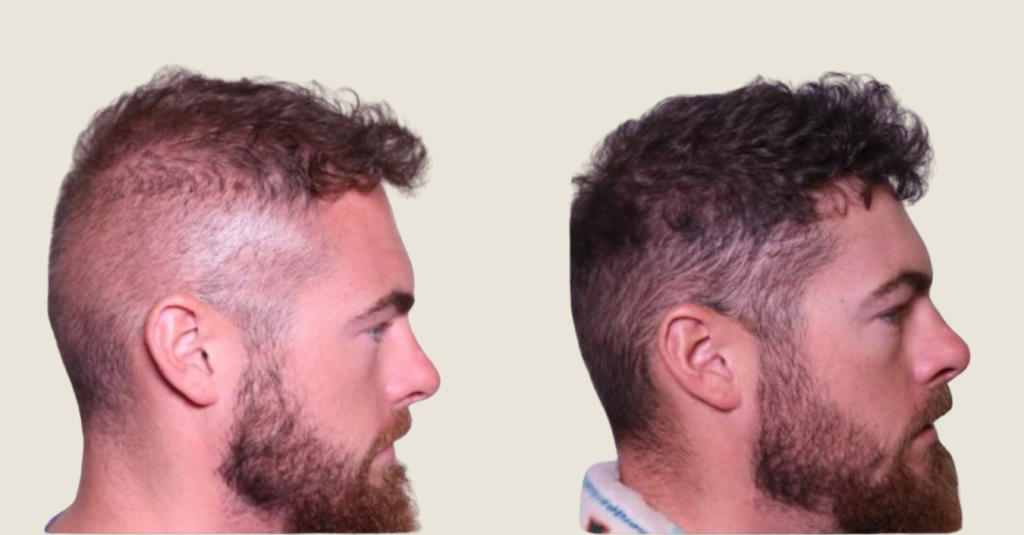
8. Before and After Context
Before: James presented with diffuse thinning across the scalp. The naturally fine hair diameter created a compounding effect — even moderate thinning was highly visible, particularly in outdoor Australian light and when hair was wet. The curl pattern that characterises James’s hair type was unable to add meaningful visual volume.
After: Hair density is substantially restored. The combination of new growth and improved hair shaft quality means the curl pattern is now working in James’s favour — adding volume and texture rather than highlighting thinning. Colour is visibly richer.
Photography notes: Before and after images should be evaluated under consistent lighting conditions. James’s hair is naturally curly, meaning length and styling will influence presentation in images. The most clinically accurate comparison points are images taken in neutral indoor light with hair in a natural, unstyled state.
9. Patient Experience
James describes himself as not having been “religiously” compliant throughout the program — he travelled, missed sessions, and occasionally ran out of products. This is a realistic representation of how many patients manage long-term treatment programs. Despite this, his results were sustained.
His compliance during the initial intensive phase (weekly clinic visits in the first months of treatment) is likely the key variable. Debra notes that early-stage consistency is the most critical window for establishing follicle response.
Compliance summary:
- Early phase: high compliance, twice weekly in-clinic laser, regular helmet use
- Mid phase: some gaps due to travel and running out of products
- Maintenance (ongoing, 4 years): consistent helmet use twice per week, topical lotion as required
Lifestyle and confidence changes:
– James reports he is no longer self-conscious at the beach, swimming, or in outdoor social settings
– He no longer avoids situations where a hat is not appropriate
– Multiple people in his life commented that he looked like a “completely different person”
– Self-described confidence increase across social, professional, and personal contexts
Client quote:
“It was life-changing, really. Your confidence is a lot higher. I’m not self-conscious going swimming anymore, not self-conscious going to the beach, not self-conscious going anywhere.”
10. Key Takeaways — Clinician Insight
What made this case successful:
- Patient age at commencement: late twenties, with relatively recent acceleration of thinning
- Scalp condition was responsive with no significant pathological barriers
- Strong early response within the first fortnight reinforced patient commitment
- A genuine multi-modal approach targeting both the scalp environment and hair shaft quality
What type of patient this result is most relevant to:
- Men in their 20s and 30s with diffuse thinning
- Patients with a genetic predisposition to fine or thinning hair who have not yet reached an advanced stage
- Patients who have previously been told treatment is not viable — this case demonstrates that early-generation clinical advice does not always reflect what current treatment protocols can achieve
Lessons for similar cases:
- Early-phase compliance is the most important variable, even if long-term maintenance is imperfect
- Patients with naturally fine hair at baseline can still achieve meaningful density improvement — the benchmark is relative, not absolute
- Managing patient expectations at the outset is important, but so is clinical confidence: Debra’s directness about expected outcomes played a role in James’s decision to proceed
Limitations to note:
- James has always had naturally fine hair. His “after” result reflects a significant improvement over his presenting condition, not the density of someone who started with thick hair. Patients should be evaluated on their own baseline.
- Some variability during maintenance did not appear to affect long-term results in this case. This may not apply equally to all patients.
11. Suitability Guidance
This case is most relevant for:
- Men aged 20–40 presenting with diffuse thinning or early-to-moderate androgenetic hair loss
- Patients with a family history of hair thinning who are beginning to see progression
- Patients who have been told hair loss is not treatable and are seeking a second opinion
- Patients who have moved to Australia from a different climate and noticed an acceleration in thinning due to sun exposure
Who may not get the same result:
- Patients at a more advanced stage of hair loss, or those who have experienced significant scalp changes over many years, may require a longer treatment timeline or different treatment approach
- Patients with hair loss caused by acute medical conditions will need a different clinical assessment
- Older patients with extended periods of hair loss should expect a longer response time — though results are still achievable
On timing:
Debra’s clinical observation is consistent across cases: the earlier treatment begins, the faster and more complete the response. For men in their 20s, full maintenance status within three months is achievable. Waiting does not preserve options — it reduces them. If you are noticing the beginning of thinning, the best time to book a free consultation is now. Stop the loss. Start today.
Thinning Out? Perth’s Hair Replacement & Restoration Experts
With these factors in mind, allow our experienced hair loss specialists to determine the best hair replacement and regrowth solution for you.
Book an appointment today at our clinic in Perth, WA or call us today on 9388 2884, and we can help you take the first step towards hair restoration.
Book a free Consultation Let us find a hair loss solution for you
If you’ve been dreaming about how your hair used to be or have caught yourself admiring other people’s beautiful hair, you’ve come to the right place.
HAIR CARE PRODUCTS THAT ACTUALLY WORK Stop the loss and start regaining growth with quality products.
Built with 30+ years experience in the industry our products are developed with cutting-edge research and high concentration active ingredients, offering you hair care products that actually deliver results.