
What Causes Male Hair Loss?
There is much to know about male hair loss – including the different types and self-diagnosis. We’ve mapped out everything you need to know so you can be well informed and take the necessary action in getting your hair restoration back on track.
Male hairloss is due to several factors including:
What Is Male Pattern Baldness?
A genetic condition, Male Pattern Baldness, despite the claims that it comes from the mother’s side, can actually be passed down from either side of the family tree. MPB is a condition caused by a bi-product of testosterone called dihydrotestosterone, or DHT. This hormone attaches to the hair follicles, causing them to shrink over time, hence resulting in thinning hair, or complete baldness at the crown of the head and frontal hairlines.
Am I Losing My Hair? Should I Be Worried? When you need to seek help
Strange as it may sound, many men are not aware they might be losing their hair until it is too late. Some may simply be in denial, or others may see it as a slow process and nothing to worry about. At the other end of the spectrum, there are men who worry about losing their hair when they don’t need to worry at all.
What are the signs?
THINNING
Noticing your hair thinning or your hairline receding
Shedding
Finding excessive hair on your pillow, the shower floor or bathtub, or on your hands when styling your hair, especially in the morning
COMMENTS
Others commenting on your thinning hair – you may be blissfully unaware
Identifying Male Pattern Baldness Where does it start?
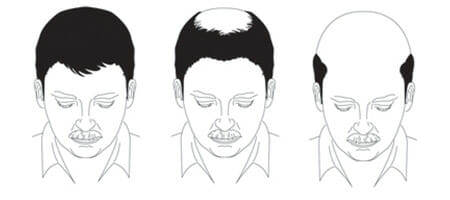
The best place to start when trying to identify MPB is at the top of the scalp, not the sides or back of the head. Look for a horseshoe shaped pattern of hair-loss or a thinning crown, a receding hairline or general thinning spread over the top area of the head.
Treating Male Pattern Baldness There are solutions
The news is good for men with Male Pattern Baldness who still have some of their hair – but it’s vitally important to choose the right treatment – whether the solution is medical, surgical or a combination of the two. There are many inferior products on the market with next to no efficacy which is a general waste of your precious time and money. It is therefore important that you invest in adequate research on how you are going to approach and treat your hair loss.
When Should I Seek A Solution For My Hair Loss? Whats the process?
We recommend you seek advice from a specialist as soon as you notice your hair thinning or increased shedding of your hair. Male Pattern Hair Loss is a chronic condition and if not treated, will progress over time. Full recovery is less likely if you ignore the signs of thinning and shedding hair, which is why our specialists at Boss Clinic always advise on using a course of treatment before the condition progresses.
How Much Of My Hair Will Grow Back? What to Expect
Every situation is different – and while some men respond exceptionally well to treatment others may find moderate success or at the very least, hair loss stabilisation – which in our opinion, is still worth celebrating! By starting a regrowth program consisting of clinically proven treatments and carefully considered hair regrowth boosters, many men will see significant regrowth in 3-6 months.
Patterns Of Hair Loss & Hair Loss Conditions
It is likely you will identify with one of the common Male Hair Loss patterns below. While Male Pattern Hair Loss is by far the most common form of hair loss in men, there are some exceptions.
Also known as a widow’s peak, the receding hair line is one of the most common patterns of hair loss.
This is when the hair is lost either side of the forehead, usually leaving a triangular peak in the middle.
This might be the only area of hair loss for some men, whereas others might experience thinning of the crown as well.
With aggressive forms of MPB, the hairline will recede until it meets the crown (which might also mean balding) or result in a large bald area at the top or front of the head.
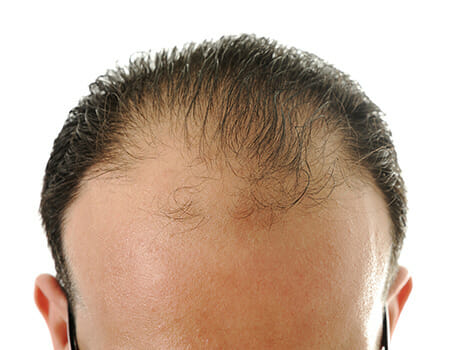
When hair loss is spread evenly over the top of the scalp, it is called general thinning.
This is a less common form of hair loss and as it less obvious, may not be noticed for some time.
When detected early, this form of thinning can be prevented and in some cases, reversed.
It is not general thinning If you are losing hair from the back and sides of your head.
Please refer to our other hair loss conditions for more information.
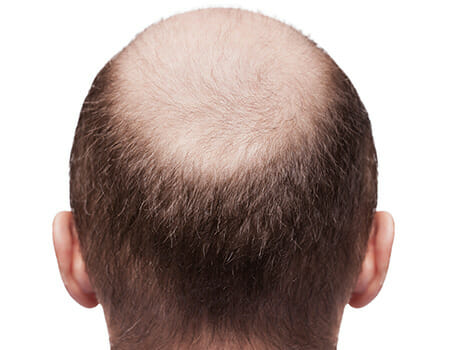
Thinning at the back or top of the head is a common condition called the ‘crown’ or ‘vertex’.
Usually this condition is stand-alone, although for some, it might coincide with a receding hairline.
Thinning begins at the crown where it starts to become visible and a bald patch might develop and become larger overtime. This type of hair loss will not correct itself without treatment.
Every situation is different, but the bald patch may progress until it meets a receding hair line or cause a prominent area of baldness at the top or back of the head.
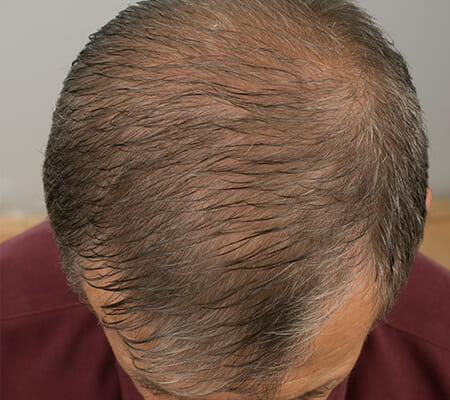
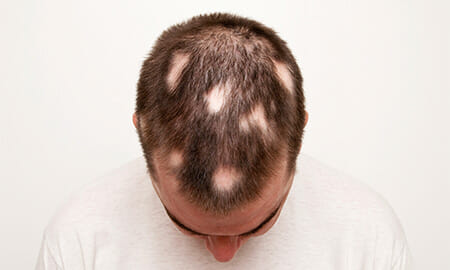
Alopecia Areata is a condition that causes sudden bald patches.
These can range in size from very small pea-sized spots to tennis-ball sized patches. It can appear any time in life. In severe forms of Alopecia Areata, like Alopecia Totalis or Alopecia Universalis, there can be total loss of body hair (Universalis). Both these forms are very rare.
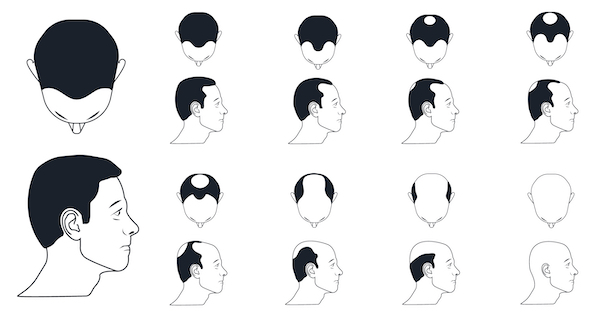
THE NORWOOD SCALE
The Norwood Scale is an excellent pictorial reference which demonstrates the progression of MPB in its many forms of a receding hair line and thinning crown.
Take the Step Perth’s Hair Replacement & Restoration Experts
With these factors in mind, allow our experienced hair loss specialists to determine the best hair replacement and regrowth solution for you. Book an appointment today at our clinic in Perth, WA or call us today on 9388 2884, and we can help you take the first step towards hair restoration.
Frequently Asked Questions
Several factors can contribute to male hair loss, including:
- Hormones: Dihydrotestosterone (DHT), a byproduct of testosterone, shrinks hair follicles over time, leading to thinning and balding.
- Stress: Chronic stress can disrupt the hair growth cycle, causing temporary or permanent hair loss.
- Diet: Poor nutrition can deprive hair follicles of essential nutrients, leading to thinning and weakness.
- Lifestyle factors: Smoking, excessive alcohol consumption, and lack of sleep can all contribute to hair loss.
- Medication: Certain medications, like chemotherapy drugs, can cause temporary or permanent hair loss.
